7 Minimalist Bedroom Wall Art Ideas That Actually Help You Sleep
Most people choose bedroom wall art the same way they pick a throw pillow: whatever looks nice in the moment. But your bedroom isn't just another room. It's where your nervous system tries to downshift after sixteen hours of input. The art you hang matters more than you think. Not because it needs to be calming in some vague, spa-music sort of way, but because what you see last before sleep and first upon waking literally shapes how your body settles or activates. This isn't about pretty. It's about quiet that works.
Guide
Guide
Guide
Article
Article
Article
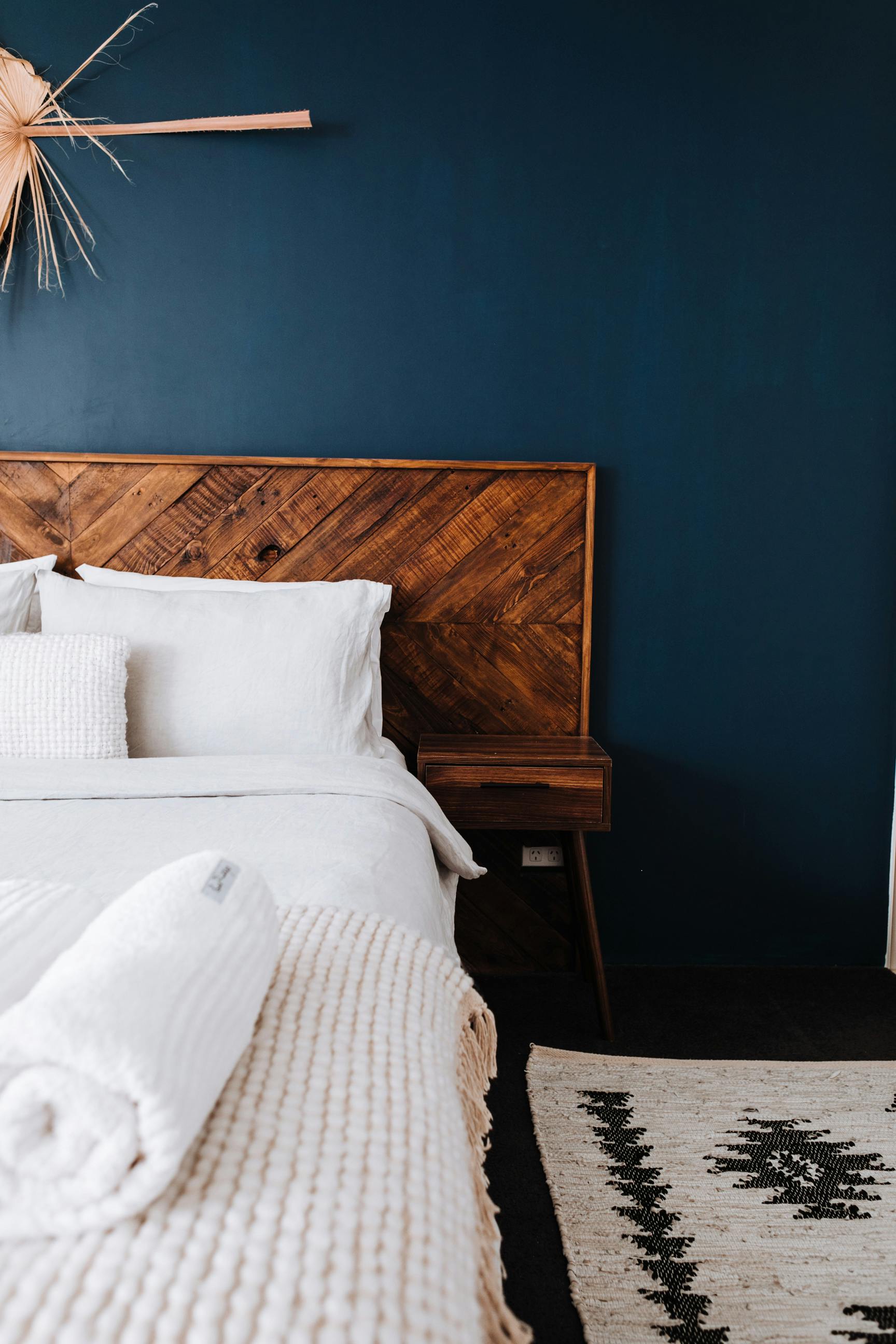
1. Color Temperature That Doesn't Stimulate
Your eyes register color temperature before your conscious mind catches up. Cool blues and harsh whites signal daylight, alertness, staying awake. Warm neutrals, soft earth tones, muted greens tell your body it's safe to power down. This is why scrolling your phone (blue light, high contrast) keeps you wired, and why that bright abstract print might look stunning but leaves you staring at the ceiling at 2 AM.
For bedroom walls, think warmth without intensity. Prints in warm sand, deep charcoal, soft clay, or muted teal create visual quiet. These aren't trendy colors. They're the shades that let your gaze rest without effort. When you're choosing art, hold it up and ask: does this feel like the last thing I want to see before I close my eyes? If it's energizing, save it for the kitchen.
[IMAGE: Bedroom with warm-toned minimalist print above bed, soft natural light, neutral bedding]
[ALT: Warm neutral minimalist bedroom wall art in sand and charcoal tones above bed with white linens]
2. Geometry That Grounds Instead of Activates
Shapes carry meaning your body reads without translation. Sharp angles, jagged lines, asymmetry: these keep your eyes moving, searching for resolution. Circles, horizons, triangles rooted at the base: these let your gaze settle. It's the difference between a question and a period.
Prints with grounding geometry, like horizon lines or stable triangular forms, offer your nervous system a visual anchor. [PRODUCT LINK: "You are held here" > /products/you-are-held-here] uses the triangle as a symbol of stability, the kind your body recognizes as safe. You don't need to analyze it. You just feel more settled looking at it. That's the point. Geometry that doesn't demand anything from you.
3. Placement at Actual Eye Level from Your Bed
Here's what most people get wrong: they hang art at standing eye level, which means lying in bed you're staring at the bottom third of the frame or craning your neck. Your bedroom art should be positioned for where you actually spend time looking at it, which is horizontal.
Sit in bed in your normal sleep position. Where does your gaze naturally land when you look at the wall? That's where the center of your art should be. Often this means hanging prints lower than you think, sometimes just 12-18 inches above the headboard instead of the standard 6-8. You want to see the piece fully, effortlessly, without lifting your head off the pillow. If you have to work to see it, it's not doing its job.
4. Text That Gives Permission, Not Commands
Motivational posters shout. They tell you to rise, grind, manifest, achieve. That energy might work in an office. It has no place in a bedroom. What you need on your walls at night isn't a pep talk. It's permission to stop performing.
[PRODUCT LINK: "Rest here" > /products/rest-here] doesn't tell you to do anything. It just names what the space is for. [PRODUCT LINK: "Sanctuary" > /products/sanctuary] reminds you this room is set apart. Simple, quiet language that doesn't add to your mental load. The words should feel like exhaling, not like another item on tomorrow's list. Choose prints with text that lets you be exactly as you are in this moment, tired and human and enough.
[IMAGE: Close-up of "Rest here" print in bedroom setting, soft focus, calm composition]
[ALT: Minimalist rest here wall art print in bedroom with gentle typography and warm tones]
5. Negative Space That Lets Your Mind Wander
Visual clutter is cognitive load. Busy patterns, dense compositions, lots of small details: your brain has to process all of it, even when you're trying to wind down. Minimalist art works in bedrooms not because it's trendy, but because it leaves room for your thoughts to spread out instead of getting tangled in what you're looking at.
Look for prints with generous negative space. Sparse compositions. A single element against a clean background. Breathing room. This is why [INTERNAL LINK: the Grounding Collection > /collections/grounding-collection] centers each design in open space rather than filling the frame edge to edge. Your eyes need somewhere to rest that isn't another thing to decode. The emptiness isn't wasted. It's the whole point.
6. Size Proportional to the Wall, Not the Furniture
A tiny 8x10 print above a queen bed looks like an afterthought. An oversized gallery wall in a small bedroom feels like the walls are closing in. Scale matters for how safe and held a space feels. Too small reads as insignificant. Too large reads as overwhelming. You're looking for proportional presence.
For above a bed, aim for a print (or grouping) that spans roughly two-thirds the width of your headboard. If you don't have a headboard, think about two-thirds of your mattress width. This creates visual weight without crowding. A single large print often works better than multiple small ones because it gives your eye one place to land instead of several. Simplicity scales.
[INTERNAL LINK: Printing and sizing guide > /pages/printing-guide] can help you think through dimensions if you're printing at home or through a local shop.
7. Frames That Disappear Into the Background
Your frame shouldn't compete with your need for rest. Ornate gold frames, thick black borders, bright white mats: these all draw attention to themselves. In a bedroom, you want the frame to recede. Thin profiles. Wood tones that match your furniture. Neutral colors that blend with your walls.
Or skip the frame entirely. Some prints hold their own weight just clipped to the wall or propped on a shelf. The goal is to let the art itself do the settling work without the frame adding more visual input. If you're going to frame, choose something so quiet you almost forget it's there. The art is the anchor. The frame is just the container.
[IMAGE: Bedroom gallery wall with thin natural wood frames, cohesive neutral palette, minimal styling]
[ALT: Minimalist bedroom wall art in natural wood frames with calming neutral color palette]
How to Choose the Right Minimalist Bedroom Art
Start with how you want to feel when you walk into your bedroom at the end of a long day. Not how you want the room to look to guests. How you want your body to respond. Do you need grounding? Permission to rest? A visual reminder that this space holds you?
If you're drawn to stability and safety, look for prints with grounding geometry: triangles, horizon lines, anchored shapes. Prints like [PRODUCT LINK: "Safe harbor" > /products/safe-harbor] or [PRODUCT LINK: "Within these walls" > /products/within-these-walls] use these visual cues intentionally. If you need the space to feel softer, choose warm neutrals and gentle language. If your bedroom currently feels like just another place you collapse, choose art that redefines the space as sanctuary.
Not sure where to start? [INTERNAL LINK: Take the Sanctuary Quiz > /pages/quiz] to figure out which collection speaks to what you're creating. Or ask yourself: what's the last thought I want in my head before sleep? Let that guide you. Your walls should echo that thought back to you, quietly, every single night.
The best bedroom art doesn't announce itself. It just makes the room feel like it's holding you a little more steadily than it did before. That's the shift you're after.
You don't have to overhaul your whole bedroom. Sometimes one print in the right spot, at the right height, in the right color, is enough to change how you settle at night. Start small. Pay attention to what actually makes you exhale when you see it. That's the art worth hanging.
What does your bedroom currently make you feel when you walk in at the end of the day?
1. Color Temperature That Doesn't Stimulate
Your eyes register color temperature before your conscious mind catches up. Cool blues and harsh whites signal daylight, alertness, staying awake. Warm neutrals, soft earth tones, muted greens tell your body it's safe to power down. This is why scrolling your phone (blue light, high contrast) keeps you wired, and why that bright abstract print might look stunning but leaves you staring at the ceiling at 2 AM.
For bedroom walls, think warmth without intensity. Prints in warm sand, deep charcoal, soft clay, or muted teal create visual quiet. These aren't trendy colors. They're the shades that let your gaze rest without effort. When you're choosing art, hold it up and ask: does this feel like the last thing I want to see before I close my eyes? If it's energizing, save it for the kitchen.
[IMAGE: Bedroom with warm-toned minimalist print above bed, soft natural light, neutral bedding]
[ALT: Warm neutral minimalist bedroom wall art in sand and charcoal tones above bed with white linens]
2. Geometry That Grounds Instead of Activates
Shapes carry meaning your body reads without translation. Sharp angles, jagged lines, asymmetry: these keep your eyes moving, searching for resolution. Circles, horizons, triangles rooted at the base: these let your gaze settle. It's the difference between a question and a period.
Prints with grounding geometry, like horizon lines or stable triangular forms, offer your nervous system a visual anchor. [PRODUCT LINK: "You are held here" > /products/you-are-held-here] uses the triangle as a symbol of stability, the kind your body recognizes as safe. You don't need to analyze it. You just feel more settled looking at it. That's the point. Geometry that doesn't demand anything from you.
3. Placement at Actual Eye Level from Your Bed
Here's what most people get wrong: they hang art at standing eye level, which means lying in bed you're staring at the bottom third of the frame or craning your neck. Your bedroom art should be positioned for where you actually spend time looking at it, which is horizontal.
Sit in bed in your normal sleep position. Where does your gaze naturally land when you look at the wall? That's where the center of your art should be. Often this means hanging prints lower than you think, sometimes just 12-18 inches above the headboard instead of the standard 6-8. You want to see the piece fully, effortlessly, without lifting your head off the pillow. If you have to work to see it, it's not doing its job.
4. Text That Gives Permission, Not Commands
Motivational posters shout. They tell you to rise, grind, manifest, achieve. That energy might work in an office. It has no place in a bedroom. What you need on your walls at night isn't a pep talk. It's permission to stop performing.
[PRODUCT LINK: "Rest here" > /products/rest-here] doesn't tell you to do anything. It just names what the space is for. [PRODUCT LINK: "Sanctuary" > /products/sanctuary] reminds you this room is set apart. Simple, quiet language that doesn't add to your mental load. The words should feel like exhaling, not like another item on tomorrow's list. Choose prints with text that lets you be exactly as you are in this moment, tired and human and enough.
[IMAGE: Close-up of "Rest here" print in bedroom setting, soft focus, calm composition]
[ALT: Minimalist rest here wall art print in bedroom with gentle typography and warm tones]
5. Negative Space That Lets Your Mind Wander
Visual clutter is cognitive load. Busy patterns, dense compositions, lots of small details: your brain has to process all of it, even when you're trying to wind down. Minimalist art works in bedrooms not because it's trendy, but because it leaves room for your thoughts to spread out instead of getting tangled in what you're looking at.
Look for prints with generous negative space. Sparse compositions. A single element against a clean background. Breathing room. This is why [INTERNAL LINK: the Grounding Collection > /collections/grounding-collection] centers each design in open space rather than filling the frame edge to edge. Your eyes need somewhere to rest that isn't another thing to decode. The emptiness isn't wasted. It's the whole point.
6. Size Proportional to the Wall, Not the Furniture
A tiny 8x10 print above a queen bed looks like an afterthought. An oversized gallery wall in a small bedroom feels like the walls are closing in. Scale matters for how safe and held a space feels. Too small reads as insignificant. Too large reads as overwhelming. You're looking for proportional presence.
For above a bed, aim for a print (or grouping) that spans roughly two-thirds the width of your headboard. If you don't have a headboard, think about two-thirds of your mattress width. This creates visual weight without crowding. A single large print often works better than multiple small ones because it gives your eye one place to land instead of several. Simplicity scales.
[INTERNAL LINK: Printing and sizing guide > /pages/printing-guide] can help you think through dimensions if you're printing at home or through a local shop.
7. Frames That Disappear Into the Background
Your frame shouldn't compete with your need for rest. Ornate gold frames, thick black borders, bright white mats: these all draw attention to themselves. In a bedroom, you want the frame to recede. Thin profiles. Wood tones that match your furniture. Neutral colors that blend with your walls.
Or skip the frame entirely. Some prints hold their own weight just clipped to the wall or propped on a shelf. The goal is to let the art itself do the settling work without the frame adding more visual input. If you're going to frame, choose something so quiet you almost forget it's there. The art is the anchor. The frame is just the container.
[IMAGE: Bedroom gallery wall with thin natural wood frames, cohesive neutral palette, minimal styling]
[ALT: Minimalist bedroom wall art in natural wood frames with calming neutral color palette]
How to Choose the Right Minimalist Bedroom Art
Start with how you want to feel when you walk into your bedroom at the end of a long day. Not how you want the room to look to guests. How you want your body to respond. Do you need grounding? Permission to rest? A visual reminder that this space holds you?
If you're drawn to stability and safety, look for prints with grounding geometry: triangles, horizon lines, anchored shapes. Prints like [PRODUCT LINK: "Safe harbor" > /products/safe-harbor] or [PRODUCT LINK: "Within these walls" > /products/within-these-walls] use these visual cues intentionally. If you need the space to feel softer, choose warm neutrals and gentle language. If your bedroom currently feels like just another place you collapse, choose art that redefines the space as sanctuary.
Not sure where to start? [INTERNAL LINK: Take the Sanctuary Quiz > /pages/quiz] to figure out which collection speaks to what you're creating. Or ask yourself: what's the last thought I want in my head before sleep? Let that guide you. Your walls should echo that thought back to you, quietly, every single night.
The best bedroom art doesn't announce itself. It just makes the room feel like it's holding you a little more steadily than it did before. That's the shift you're after.
You don't have to overhaul your whole bedroom. Sometimes one print in the right spot, at the right height, in the right color, is enough to change how you settle at night. Start small. Pay attention to what actually makes you exhale when you see it. That's the art worth hanging.
What does your bedroom currently make you feel when you walk in at the end of the day?
1. Color Temperature That Doesn't Stimulate
Your eyes register color temperature before your conscious mind catches up. Cool blues and harsh whites signal daylight, alertness, staying awake. Warm neutrals, soft earth tones, muted greens tell your body it's safe to power down. This is why scrolling your phone (blue light, high contrast) keeps you wired, and why that bright abstract print might look stunning but leaves you staring at the ceiling at 2 AM.
For bedroom walls, think warmth without intensity. Prints in warm sand, deep charcoal, soft clay, or muted teal create visual quiet. These aren't trendy colors. They're the shades that let your gaze rest without effort. When you're choosing art, hold it up and ask: does this feel like the last thing I want to see before I close my eyes? If it's energizing, save it for the kitchen.
[IMAGE: Bedroom with warm-toned minimalist print above bed, soft natural light, neutral bedding]
[ALT: Warm neutral minimalist bedroom wall art in sand and charcoal tones above bed with white linens]
2. Geometry That Grounds Instead of Activates
Shapes carry meaning your body reads without translation. Sharp angles, jagged lines, asymmetry: these keep your eyes moving, searching for resolution. Circles, horizons, triangles rooted at the base: these let your gaze settle. It's the difference between a question and a period.
Prints with grounding geometry, like horizon lines or stable triangular forms, offer your nervous system a visual anchor. [PRODUCT LINK: "You are held here" > /products/you-are-held-here] uses the triangle as a symbol of stability, the kind your body recognizes as safe. You don't need to analyze it. You just feel more settled looking at it. That's the point. Geometry that doesn't demand anything from you.
3. Placement at Actual Eye Level from Your Bed
Here's what most people get wrong: they hang art at standing eye level, which means lying in bed you're staring at the bottom third of the frame or craning your neck. Your bedroom art should be positioned for where you actually spend time looking at it, which is horizontal.
Sit in bed in your normal sleep position. Where does your gaze naturally land when you look at the wall? That's where the center of your art should be. Often this means hanging prints lower than you think, sometimes just 12-18 inches above the headboard instead of the standard 6-8. You want to see the piece fully, effortlessly, without lifting your head off the pillow. If you have to work to see it, it's not doing its job.
4. Text That Gives Permission, Not Commands
Motivational posters shout. They tell you to rise, grind, manifest, achieve. That energy might work in an office. It has no place in a bedroom. What you need on your walls at night isn't a pep talk. It's permission to stop performing.
[PRODUCT LINK: "Rest here" > /products/rest-here] doesn't tell you to do anything. It just names what the space is for. [PRODUCT LINK: "Sanctuary" > /products/sanctuary] reminds you this room is set apart. Simple, quiet language that doesn't add to your mental load. The words should feel like exhaling, not like another item on tomorrow's list. Choose prints with text that lets you be exactly as you are in this moment, tired and human and enough.
[IMAGE: Close-up of "Rest here" print in bedroom setting, soft focus, calm composition]
[ALT: Minimalist rest here wall art print in bedroom with gentle typography and warm tones]
5. Negative Space That Lets Your Mind Wander
Visual clutter is cognitive load. Busy patterns, dense compositions, lots of small details: your brain has to process all of it, even when you're trying to wind down. Minimalist art works in bedrooms not because it's trendy, but because it leaves room for your thoughts to spread out instead of getting tangled in what you're looking at.
Look for prints with generous negative space. Sparse compositions. A single element against a clean background. Breathing room. This is why [INTERNAL LINK: the Grounding Collection > /collections/grounding-collection] centers each design in open space rather than filling the frame edge to edge. Your eyes need somewhere to rest that isn't another thing to decode. The emptiness isn't wasted. It's the whole point.
6. Size Proportional to the Wall, Not the Furniture
A tiny 8x10 print above a queen bed looks like an afterthought. An oversized gallery wall in a small bedroom feels like the walls are closing in. Scale matters for how safe and held a space feels. Too small reads as insignificant. Too large reads as overwhelming. You're looking for proportional presence.
For above a bed, aim for a print (or grouping) that spans roughly two-thirds the width of your headboard. If you don't have a headboard, think about two-thirds of your mattress width. This creates visual weight without crowding. A single large print often works better than multiple small ones because it gives your eye one place to land instead of several. Simplicity scales.
[INTERNAL LINK: Printing and sizing guide > /pages/printing-guide] can help you think through dimensions if you're printing at home or through a local shop.
7. Frames That Disappear Into the Background
Your frame shouldn't compete with your need for rest. Ornate gold frames, thick black borders, bright white mats: these all draw attention to themselves. In a bedroom, you want the frame to recede. Thin profiles. Wood tones that match your furniture. Neutral colors that blend with your walls.
Or skip the frame entirely. Some prints hold their own weight just clipped to the wall or propped on a shelf. The goal is to let the art itself do the settling work without the frame adding more visual input. If you're going to frame, choose something so quiet you almost forget it's there. The art is the anchor. The frame is just the container.
[IMAGE: Bedroom gallery wall with thin natural wood frames, cohesive neutral palette, minimal styling]
[ALT: Minimalist bedroom wall art in natural wood frames with calming neutral color palette]
How to Choose the Right Minimalist Bedroom Art
Start with how you want to feel when you walk into your bedroom at the end of a long day. Not how you want the room to look to guests. How you want your body to respond. Do you need grounding? Permission to rest? A visual reminder that this space holds you?
If you're drawn to stability and safety, look for prints with grounding geometry: triangles, horizon lines, anchored shapes. Prints like [PRODUCT LINK: "Safe harbor" > /products/safe-harbor] or [PRODUCT LINK: "Within these walls" > /products/within-these-walls] use these visual cues intentionally. If you need the space to feel softer, choose warm neutrals and gentle language. If your bedroom currently feels like just another place you collapse, choose art that redefines the space as sanctuary.
Not sure where to start? [INTERNAL LINK: Take the Sanctuary Quiz > /pages/quiz] to figure out which collection speaks to what you're creating. Or ask yourself: what's the last thought I want in my head before sleep? Let that guide you. Your walls should echo that thought back to you, quietly, every single night.
The best bedroom art doesn't announce itself. It just makes the room feel like it's holding you a little more steadily than it did before. That's the shift you're after.
You don't have to overhaul your whole bedroom. Sometimes one print in the right spot, at the right height, in the right color, is enough to change how you settle at night. Start small. Pay attention to what actually makes you exhale when you see it. That's the art worth hanging.
What does your bedroom currently make you feel when you walk in at the end of the day?
Our articles
Guide
7 Minimalist Bedroom Wall Art Ideas That Actually Help You Sleep

Guide
Therapeutic Wall Colors That Hold You Gently
Guide
Minimalist Cozy Decor for Anxious Minds: When Less Becomes More Healing
Guide
7 Minimalist Bedroom Wall Art Ideas That Actually Help You Sleep
Guide